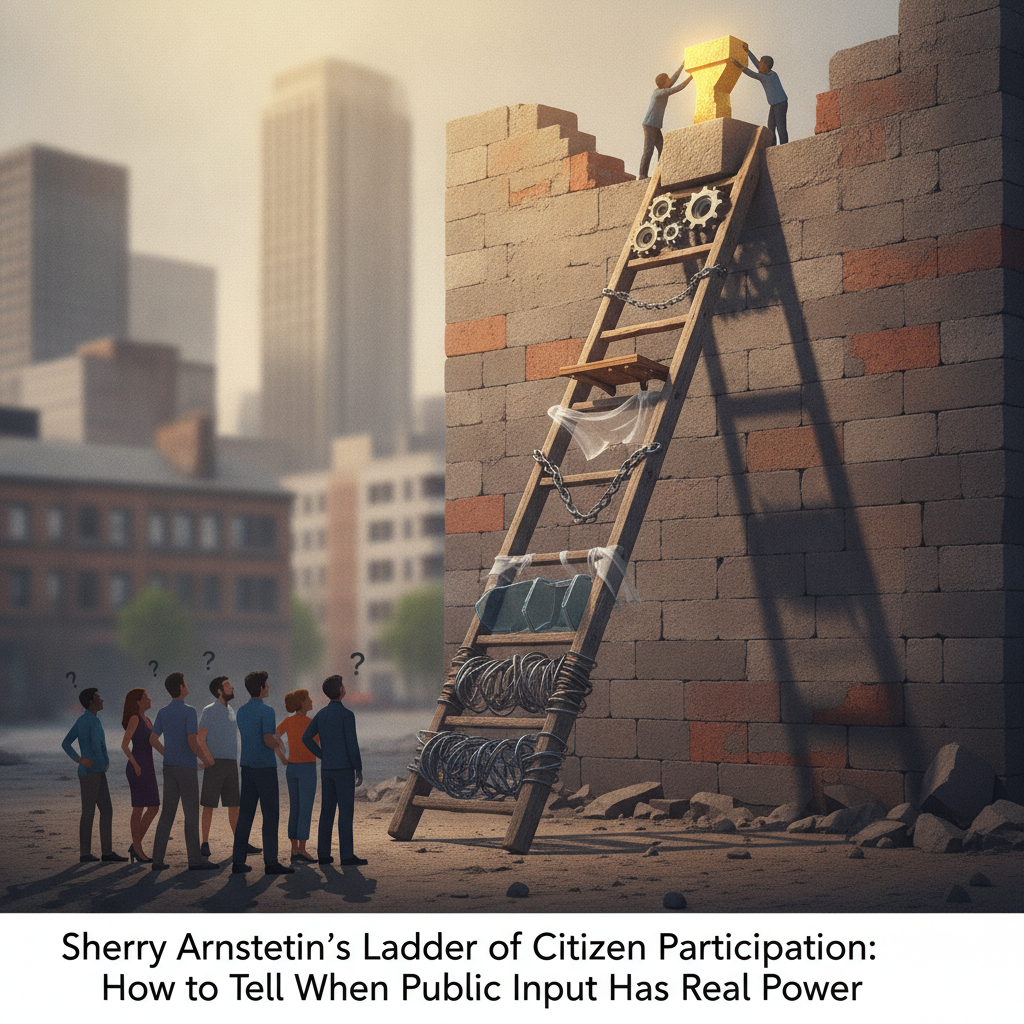
People are often invited to meetings, surveys, hearings, and committees and told, “We want your input.” That phrase can mean very different things. Sometimes it means real influence. Sometimes it means only a chance to speak. Sherry R. Arnstein’s A Ladder of Citizen Participation helps ordinary people tell the difference.
Arnstein’s work appeared in 1969 as an article in the Journal of the American Institute of Planners. People sometimes search for “her book,” but her famous ladder was not a book; it was a widely discussed article written during a period when many institutions were facing hard questions about who gets heard, who gets counted, and who actually holds power in public decisions.
The Big Idea: Participation Is Not the Same as Power
Arnstein’s central point is simple: being invited into a process does not automatically mean you can change the outcome. A person may be allowed to attend a meeting, fill out a survey, speak at a hearing, or sit on a committee and still have little or no power over the final decision.
That is why one question matters throughout the ladder:
What can I actually change?
That question separates real participation from symbolic participation. It also helps people understand the difference between voice (“I am allowed to speak”), input (“They asked what I think”), influence (“My views may shape the result”), and power (“I can help decide the result”).
Arnstein’s ladder has eight rungs. She grouped them into three broad categories:
- Nonparticipation: Manipulation, Therapy
- Tokenism: Informing, Consultation, Placation
- Citizen Power: Partnership, Delegated Power, Citizen Control
The Lower Rungs: When Participation Is Mostly Theater
Nonparticipation
1. Manipulation
What it means: People are brought in to be managed, not to decide anything.
What it looks like: A school district holds a “community session,” but the agenda is really a presentation to persuade parents to accept a decision that has already been made.
What power you have: You may be present, but you cannot change the direction.
The question to ask: Is this meeting meant to hear me, or to get me to agree?
2. Therapy
What it means: The process treats the public like it needs to be fixed, rather than listened to.
What it looks like: A neighborhood conflict meeting focuses on calming residents down, teaching them to be more “understanding,” or helping them “adjust” to a project already planned.
What power you have: You may be able to express feelings, but not shape decisions.
The question to ask: Am I being asked to help solve a problem, or to accept one?
Tokenism
3. Informing
What it means: Officials or leaders tell people what is happening.
What it looks like: A city announces a road project, a company sends employees an update, or a school posts a policy change.
What power you have: You receive information, but the decision is already moving forward.
The question to ask: Am I being informed after the major choices were already made?
4. Consultation
What it means: People are asked what they think, but the final choice may not change.
What it looks like: A public survey asks residents about a park redesign, or a hearing invites comments on a new development.
What power you have: You can share ideas, concerns, and preferences, but there is no guarantee they will affect the outcome.
The question to ask: What happens to my feedback after I give it?
5. Placation
What it means: A few members of the public are given a seat at the table, but they do not hold enough power to steer the process.
What it looks like: A citizen advisory committee meets regularly, but staff or leadership still control the real decisions.
What power you have: You may influence discussion, but not necessarily the result.
The question to ask: Can the people in the room actually change the decision, or are they mostly there to make it seem inclusive?
The Higher Rungs: When People Share or Hold Real Power
Citizen Power
6. Partnership
What it means: Decision-making is shared between the public and the institution.
What it looks like: A neighborhood, school, or local agency creates a working group where residents and officials negotiate options together.
What power you have: Participants can shape the plan, not just respond to it.
The question to ask: Who has to agree before the decision is final?
7. Delegated Power
What it means: The institution gives citizens major decision-making authority over part of the process.
What it looks like: A community group is given control over how a local budget is spent for a park, program, or neighborhood project.
What power you have: You are not just consulted; you are making real choices.
The question to ask: What decisions are actually in the hands of participants?
8. Citizen Control
What it means: Citizens have the strongest power and make the key decisions themselves.
What it looks like: A community organization directly runs a project, or a neighborhood group controls a local program with minimal outside interference.
What power you have: Citizens set the agenda, decide the outcome, and oversee implementation.
The question to ask: Who is really in charge?
How to Read the Ladder in Real Life
Arnstein did not say every lower-rung process is useless. A survey can reveal important problems. A hearing can surface information. A committee can create a path toward better decisions. But she insisted that people should not confuse access with authority.
That distinction matters in everyday life. A company asking employees for feedback is not the same as employees sharing in the final decision. A town hall is not the same as a vote. A planning commission meeting is not the same as citizen control. The same is true for a school policy, a road project, a park redesign, or a new development.
The simplest way to use Arnstein’s ladder is to ask three questions:
- What am I being invited to do?
- Can I actually change the outcome?
- Who holds the final decision-making power?
If the answer is “I can speak, but not decide,” then the process may offer voice without power. If the answer is “my input may help shape the result,” then it may be tokenism or partnership, depending on how much authority participants truly have. If the answer is “we decide together” or “the community decides,” then the process is moving up the ladder.
Arnstein’s ladder remains useful because it gives ordinary people a clear way to read a process before they invest time, trust, or energy. When someone says, “We want your input,” the real question is still the same: What can I actually change?