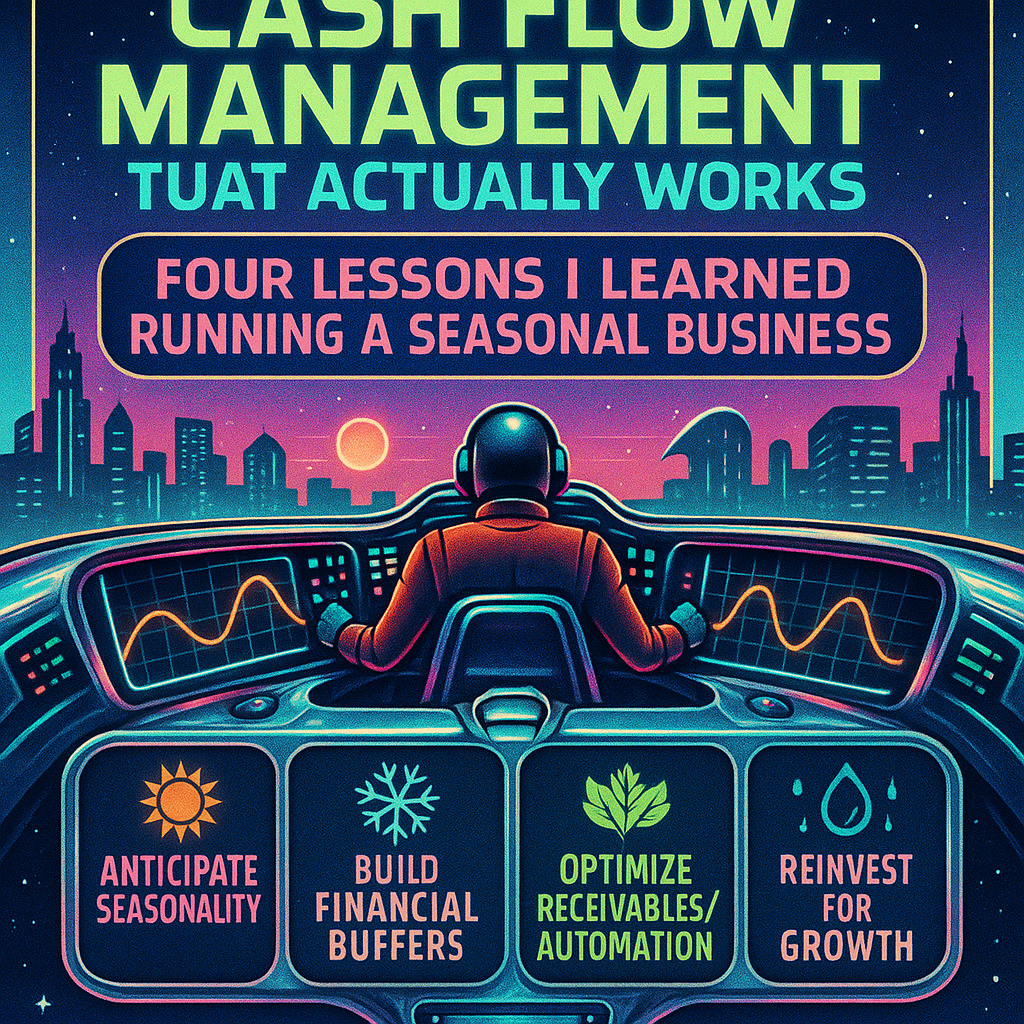
Cash flow management that actually works: four lessons I learned running a seasonal business
I learned the hard way that cash flow management is not a spreadsheet exercise. Early in my career I ran a small manufacturing business that made garden furniture. Sales boomed in spring and collapsed in late fall. One winter we had invoices piling up, a supplier holding shipments, and a payroll I could not meet. That crisis taught me five simple, repeatable practices that turn unpredictable months into predictable ones.
Below I lay out pragmatic steps client advisory providers, accountants, bookkeepers, and business coaches can use right away with their clients to stop panic and build steady working capital.
Diagnose the real cash problem, not the symptom
When a client says “we have a cash flow problem,” ask three precise questions: where is cash leaving the business, when does it arrive, and what has to be paid on fixed dates. Most owners answer with generalities. Get dates and amounts.
Run a 13-week cash forecast for the next quarter. Track inflows by expected deposit date and tag uncertain receipts. Reconcile that forecast to open AR aging and upcoming bills. If weekly projections differ materially from month-end reports, the business lives by timing, not by monthly totals.
This short diagnostic turns vague worry into clear priorities. You will quickly see whether the true issue is slow collections, excessive inventory, seasonal sales timing, or a one-off liability.
Tighten collections and make payments predictable
Speeding collections raises cash faster than cutting costs. Start with three operational changes you can implement in two weeks. First, require clearer payment terms on invoices and enforce them. Second, offer one or two simple incentives for early payment and one non‑punitive penalty for late payment. Third, automate reminders and allocate a staff member or outsourced resource to follow up the day after an invoice becomes overdue.
On the payables side, negotiate staggered payments with key suppliers. Suppliers prefer predictability. A proposal that replaces a surprise late payment with a modest short-term plan wins far more often than a demand for immediate full payment.
These moves reduce the float between when you earn and when you receive cash. That gap is where most seasonal businesses fail.
Reprice and protect margins when volumes swing
Seasonality changes unit economics. A low-volume month that uses the same fixed overhead will quickly erode margin. Review pricing and minimum order policies before the season changes. Build simple guardrails: a floor price for low-volume jobs, and a surcharge for rush requests or extended credit terms.
Use small experiments to test client elasticity. Price increases delivered alongside transparent explanations about supply costs or extended payment terms land better than mysterious raises. When possible, reallocate costs from fixed overhead to variable costs that move with volume.
If cash is tight because inventory sits unsold, apply triage. Classify stock into fast, slow, and obsolete. Move slow stock via promotion, bundle, or resale channels. Recovering cash from inventory is often faster and less damaging than additional borrowing.
Forecast scenarios and build a seasonal playbook
Create three scenarios for the next 12 months: best, base, and worst. Each scenario must include revenue by month, required payroll, supplier commitments, and a borrowing plan. Use the scenarios to test triggers: for example, if receipts fall 10% in April, postpone nonessential hires and open a line of credit.
A seasonal playbook turns reactive decisions into rehearsed responses. It should say who calls suppliers, how to tighten credit, and when to request owner injections. Put these steps in writing and run a tabletop exercise each quarter so the team knows their role before a crunch arrives.
For teams advising multiple businesses, create a template playbook that adapts to client size and seasonality. The template becomes a deliverable you can use across clients to accelerate implementation and coaching.
Midway through the planning process, consider whether a client needs a different cash management structure. For some, a separate account to hold seasonal reserves works. For others, a predictable short-term line that they only tap during off months fits better. You can find useful frameworks on improving liquidity and operational resilience in external leadership resources such as leadership. When teaching these frameworks, emphasize decisions and responsibilities over dashboards.
Reframe client conversations: stop apologizing, start advising
Owners often lead with excuses. That invites negotiation and erosion of terms. Instead, teach clients to lead billing conversations with data. A script that states expected dates, recent payment history, and a concrete next step reduces ambiguity and improves outcomes.
Help clients build a short briefing pack for key customers. The pack shows projected delivery dates, payment timelines, and how the supplier partnership benefits the customer. That transparency reduces friction around pricing changes and payment schedules.
When difficult conversations are needed, coach clients to use two truths and a clear option: state the problem, give one data point, and offer a single, fair proposal. This structure shortens negotiations and often secures better payment behavior.
A closing practical insight
Cash flow management succeeds when teams treat timing as a core operational discipline. Regular, small improvements compound. A tighter collections cadence, a simple seasonal playbook, and clear payment conversations prevent the next crisis before it starts.
When you work with clients, start with the 13-week forecast and the three scenarios. Those tools expose the levers that matter. Then push for disciplined follow-through. Over time you will move clients from fearful firefighting to predictable operations.
If a client needs to build a habit around reserves and forecasting, refer them to straightforward resources on managing liquidity and behavioral change. For specific guidance on improving seasonal working capital, explore practical content on cash flow. It is the steady practice of these basic steps that keeps businesses solvent and able to invest when opportunity arrives.