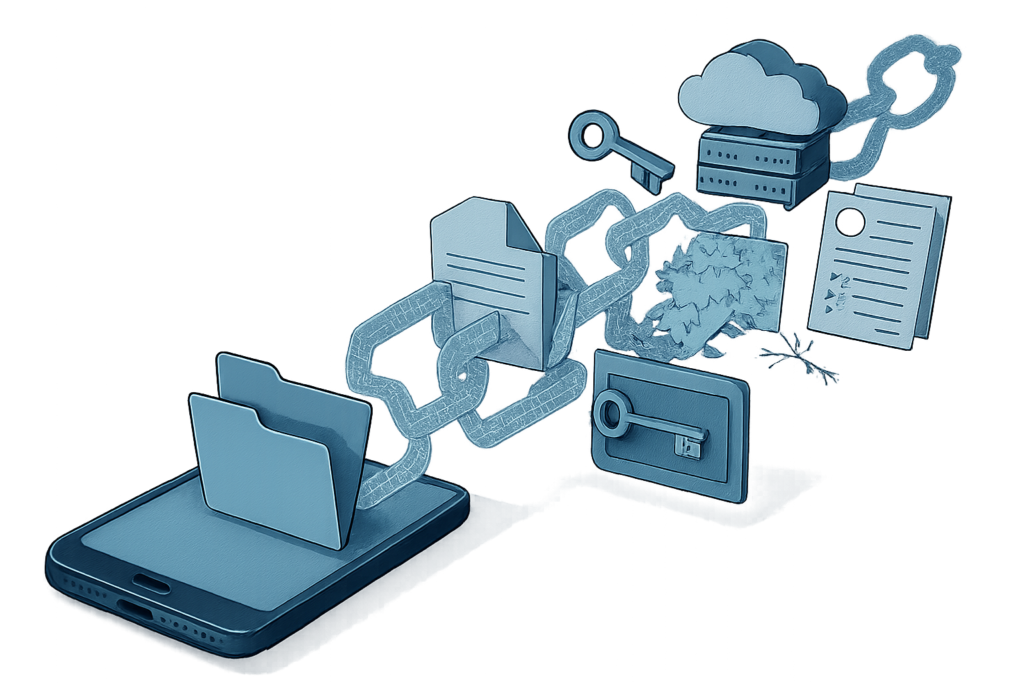
When Americans upload their lives to the cloud, the useful question is not whether a phone shows a reassuring lock icon. It is this: Where does every copy go, who possesses it, who possesses the keys, what is derived from it, which jurisdictions touch it, and who can retrieve or search it?
A cloud account can hold documents, photographs, video, email, phone backups, voice recordings, transcripts, AI conversations, location-related information, metadata, search indexes, telemetry, and app data. A privacy assessment that stops at the file itself misses the system that makes the file useful. The system may include identity services, content delivery, backup, logging, malware scanning, search, transcription, analytics, support, and machine-learning features.
Documented fact: Major cloud platforms distinguish storage encryption, key management, residency, and protection while data is being processed. Google says its default program encrypts customer content at rest, meaning on disk and backup media, while Azure separately describes residency, encryption at rest and in transit, and confidential computing for data in memory. Those are related controls, not interchangeable promises. Google Cloud documentation Microsoft Azure documentation
The file is a chain, not a place
“Stored in the United States” can be a meaningful contract term, but it is not a complete map. Primary storage is the system chosen to hold the working copy. It may be joined by replicas for durability, backups for recovery, caches for speed, indexes for search, temporary processing copies, and logs that record actions around the data. A photo can have a thumbnail, an object-recognition label, a location field, an access record, and a search entry. A recording can produce an audio object, transcript, speaker labels, summaries, embeddings, error logs, and usage analytics.
Documented fact: Google describes at-rest encryption as covering data stored on disk or backup media, which itself shows why a discussion confined to one “live” file is incomplete. Azure says residency restrictions apply to approved regions and treats encryption in use as a separate control. The details depend on the particular service and the customer’s configuration, so a provider-wide slogan should not be treated as a service-specific guarantee. Google Cloud documentation Microsoft Azure documentation
Technically possible: A single recording may travel through a product company, a transcription service, an AI model provider, an analytics vendor, a backup provider, and their subprocessors. Each stage can create a new copy or a derivative, and each company may use infrastructure in different regions. This describes an architecture that can exist, not proof that every vendor sends every customer recording across borders. The only responsible answer for a named product comes from its current service terms, data-processing addendum, subprocessor list, configuration, and contract.
Smaller AI, wearable, productivity, and recording companies deserve special scrutiny precisely because their product may be a thin layer over several other companies. The polished application may be one vendor; audio recognition, model inference, telemetry, crash reporting, email delivery, customer support, and storage may be supplied by others. A subprocessor list is not a complete threat model, but no list is a warning sign when the product continuously handles intimate data.
Unverified/speculative: It is not evidence of a secret surveillance arrangement merely to observe that a vendor has foreign infrastructure or subprocessors. Public materials reviewed for this article do not establish that U.S. agencies or cloud providers deliberately route Americans’ domestic data overseas to evade U.S. surveillance restrictions. The absence of public evidence is not proof about undisclosed activity; it is a limit on what can honestly be asserted.
Encryption answers one question, not all of them
Encryption at rest generally protects stored media from someone who obtains the raw disks or backup media without an authorized decryption path. It does not by itself mean end-to-end encryption, and it does not mean zero knowledge. In an end-to-end design, the service is designed so that only the communicating endpoints have usable plaintext for the protected content. In a zero-knowledge design, the provider is not supposed to hold what it needs to read the protected material. The exact promise matters, and so do exceptions for search, recovery, moderation, sharing, or AI features.
Documented fact: Google says that under its default encryption program it owns and manages the keys; its comparison of key-management options distinguishes Google-controlled default keys from customer-managed encryption keys. Customer-managed keys can improve control over rotation and access decisions, but they are not magic. The application still needs a permitted decryption path when it reads or processes data. Google Cloud documentation
The question “Who has the keys?” should be expanded: Who can authorize their use? Which identities can change the key policy? Where does plaintext appear? What recovery route exists? Who can administer the account? What does the software send to a processor when a user asks it to search, summarize, transcribe, or share?
Documented fact: AWS warns that anyone who possesses an access key has the same access to AWS resources as its holder. It also notes that long-term IAM and root access keys remain valid until revoked, whereas temporary credentials expire. That is why an encryption claim cannot substitute for identity and access management. AWS IAM documentation
Technically possible: A capable attacker may not need to defeat AES-256. Depending on the system, an attacker could obtain valid credentials, compromise a user endpoint, exploit a vulnerability, take over an administrator account, abuse excessive permissions, alter key policies, or obtain plaintext during an authorized processing step. Provider personnel, contractors, insiders, and hackers are all possible threat actors in the abstract. Whether any of them actually accessed a particular account is a separate evidentiary question.
Collect now, decrypt later is a planning problem, not proof of a breakthrough
Documented fact: NIST says sufficiently capable quantum computers could eventually break much widely used public-key cryptography and has released post-quantum cryptography standards, urging organizations to identify vulnerable algorithms and plan migration. This matters for long-lived secrets and recorded encrypted traffic: an actor can retain material now in the hope that a later capability makes it readable. NIST Post-Quantum Cryptography project
Unverified/speculative: “Collect now, decrypt later” is not public proof that any government or company has a cryptographically relevant quantum computer, decrypted a particular AES-256 archive, or possesses a classified universal backdoor. Public discussion should separate the well-supported transition risk from claims about unverified present-day capabilities.
Location changes the legal and intelligence context, but it is not a loophole switch
Physical location, network routing, a foreign data center, and a foreign subprocessor can matter because different entities, technical paths, and legal authorities may be involved. Yet it is simplistic to say that a packet crossing a border automatically becomes lawless, or that domestic storage automatically removes foreign exposure. Statutes and executive authorities use specific tests involving targets, location, purpose, acquisition method, and agency procedures.
Documented fact, current as of September 2026: Section 702 and the rest of FISA Title VII were automatically repealed on June 12, 2026. Before repeal, Section 702 allowed the Attorney General and Director of National Intelligence to authorize, for up to one year, targeting of non-U.S. persons reasonably believed to be outside the United States to acquire foreign-intelligence information. It prohibited intentionally targeting a known person in the United States, intentionally targeting a U.S. person abroad, and reverse targeting an overseas person as a pretext to acquire a known U.S. person’s communications. Public Law 119-87 Congressional Research Service analysis
Documented fact: Repeal did not instantly terminate surveillance already authorized. The FISA Amendments Act’s transition rules keep any pre-repeal order, authorization, or directive in effect until its stated expiration, keep Title VII applicable to that continuing activity, and preserve FISA Court oversight. CRS reports that the FISA Court authorized Section 702 activity for one year in March 2026. Because the underlying order remains classified, the precise expiration date is not independently available in the public record reviewed here. Unless Congress reinstates the authority, new programmatic surveillance under Section 702 will no longer be available after the surviving authorizations expire. Congressional Research Service analysis
That does not mean Americans’ communications are categorically absent from Section 702 holdings. If a lawful foreign target communicates with a U.S. person, the American’s communication may be acquired incidentally. The law and agency procedures then turn to minimization, retention, access, querying, and dissemination. These controls matter because collection is not the end of the story.
Documented fact: The DOJ, ODNI, NSA, CIA, and FBI describe incidental acquisition of U.S.-person communications in Section 702 collection. They say minimization procedures set retention periods and constrain use and dissemination; when a presumed foreign target is determined to be in the United States or to be a U.S. person, procedures generally require purge subject to limited exceptions. The same joint statement describes a case-specific justification requirement before FBI access to content returned by a U.S.-person query and DOJ auditing of those justifications. DOJ/ODNI Section 702 statement
Documented fact: Section 702 required query and minimization procedures and records of U.S.-person query terms. Those rules continue to govern orders, authorizations, and directives that survive temporarily under the transition provisions. An ODNI civil-liberties review says agencies receiving unminimized FISA information remain subject to their minimization rules. For nonpublic U.S.-person information, identity is generally masked unless it is foreign intelligence, necessary to understand the intelligence, or evidence of a crime. Retention limits, access controls, and authorized-recipient restrictions are controls, not a claim that human error or misuse is technically impossible. Congressional Research Service analysis ODNI civil-liberties review
Documented fact: EO 12333 says intelligence-community elements may collect, retain, or disseminate U.S.-person information only under Attorney General-approved procedures after consultation with the DNI. For collection inside the United States or directed at U.S. persons abroad, it requires the least intrusive feasible techniques and sets additional approval conditions for warrant-like techniques. Its safeguards are expressly written to apply whether information is collected inside or outside the United States. Executive Order 12333
Documented abuse or noncompliance: The 2023 joint Section 702 statement reports that DOJ identified a large number of inadvertent FBI searches of unminimized Section 702 holdings. It says FBI changed a default inclusion setting to affirmative opt-in in 2021. This is evidence that controls and audits can discover failures, not proof that every search was malicious or that all collection is unlawful. It is also a reason not to confuse written rules with a technical impossibility of unauthorized access. DOJ/ODNI Section 702 statement
Unverified/speculative: The public record reviewed here does not credibly show a deliberate program to send Americans’ domestic cloud data abroad so agencies can evade domestic restrictions. Section 702’s former reverse-targeting prohibition, which continues to govern surviving authorizations during the transition, and EO 12333’s express treatment of U.S. persons abroad cut against that theory. Oversight, inspectors general, warrants, policies, and audits constrain conduct, but no control system makes unauthorized access physically impossible. That final point is an architectural caution, not evidence of a hidden routing program.
When cloud data becomes evidence
A cloud account can become part of a criminal investigation without a dramatic “hack.” Investigators may seek preservation, then pursue the appropriate legal process for different categories of information. Content may include files, messages, recordings, or stored email. Non-content records may reveal subscriber details, IP-address history, device events, timestamps, account changes, associations, and a timeline that gives context to other evidence.
Documented fact: Under 18 U.S.C. §2703, the legal pathways for stored content and non-content records differ. The statute also permits a provider-preservation request for 90 days, renewable once. Preservation is not disclosure, and it is not authentication. A preserved object may later be sought through a subpoena, court order, warrant, or another legally authorized process depending on the information and circumstances.
That distinction is practical. A preservation notice can stop routine deletion while legal process is considered, but it does not answer whether the provider has the desired material, whether a user can still alter another copy, whether timestamps are correctly interpreted, or whether the item means what an investigator claims. The same cloud system that helps a person recover a lost phone can create a timeline useful to either side of a case.
Documented fact: NISTIR 8006 identifies cloud forensic challenges involving integrity, recovery, location, imaging, provenance, chain of custody, and decentralized or inaccessible logs. The report is a useful corrective to two lazy claims: cloud evidence is neither automatically reliable nor automatically worthless. NISTIR 8006
Integrity is an argument that must be shown
Good evidence handling asks what happened to the data from creation to courtroom. Cryptographic hashes can show that two acquired copies match at a point in time. Access logs can show recorded events. Timestamps can help establish sequence. Redundancy can protect availability. Chain-of-custody records can explain who acquired, stored, transferred, and analyzed evidence. Forensic acquisition methods can preserve an account export or provider response alongside documentation of the process.
Documented fact: Federal Rules of Evidence 901 and 902 include procedures for authenticating electronic evidence, including certified records generated by an electronic process or system and data copied from electronic devices, storage media, or files when verified by digital identification such as a hash value. Authentication is a threshold question. It does not settle hearsay, relevance, provenance, completeness, or the identity of the person who acted through an account. Federal Rules of Evidence
Technically possible: A cloud backup, file, or log can be altered by someone with sufficient authorized or unauthorized access, or can be misunderstood because of synchronization, time zones, retention settings, account sharing, or incomplete exports. Conversely, an apparently suspicious gap can reflect ordinary lifecycle behavior. The defensible approach is to compare records, document the acquisition, preserve originals where possible, and test explanations rather than treating a single dashboard view as final truth.
A practical cloud-chain audit
You cannot inspect every data center, but you can make the hidden chain less invisible. Start with your highest-consequence categories: health documents, financial records, intimate photos, legal material, children’s data, location history, recordings, work files, and AI conversations. Then ask each service concrete questions.
- What data types does the service store, generate, index, retain, and log?
- What is the primary storage region, and what are the rules for replicas, backups, caches, support access, and disaster recovery?
- Which subprocessors receive content, metadata, telemetry, transcripts, embeddings, or analytics?
- Does encryption mean at rest, in transit, in use, end-to-end, or zero knowledge? Who controls and can authorize the keys?
- Which accounts, API keys, recovery methods, endpoints, and administrators can reach plaintext or change permissions?
- Can AI, transcription, search, sharing, or diagnostics create derivatives or send content to another processor?
- What export, deletion, retention, legal-request, and incident-response terms apply?
- Can you use strong unique credentials, multi-factor authentication, temporary credentials where appropriate, encrypted devices, and independent local backups?
Documented fact: AWS recommends temporary credentials over long-term access keys to reduce the risk from exposed credentials, while NIST is urging organizations to plan migration to post-quantum cryptography. These are concrete reminders that privacy depends on operations over time, not a one-time choice of a cloud brand. AWS IAM documentation NIST Post-Quantum Cryptography project
The conclusion is not that cloud use is irrational or that every foreign processing path is abuse. It is that a file icon is the least informative view of your data. Privacy is determined by the full chain of custody, processing, replication, encryption, jurisdiction, and access behind that icon. Ask for evidence, distinguish a documented fact from documented noncompliance, technical possibility, and speculation, and do not let any one reassuring word do the work of an audit.
Sources
- Google Cloud: Default encryption at rest
- Microsoft Azure: Controls and principles
- AWS IAM: Secure access keys
- NIST: Post-Quantum Cryptography
- Public Law 119-87: final extension to June 12, 2026
- Congressional Research Service: The Impact of FISA Section 702’s Repeal
- DOJ/ODNI: Section 702 of FISA
- ODNI: U.S.-person dissemination review
- Executive Order 12333
- 18 U.S.C. §2703
- NISTIR 8006
- Federal Rules of Evidence